“Mapping the Past in 3D: The Use of Maps in 3D Digital Storytelling” at CHNT25
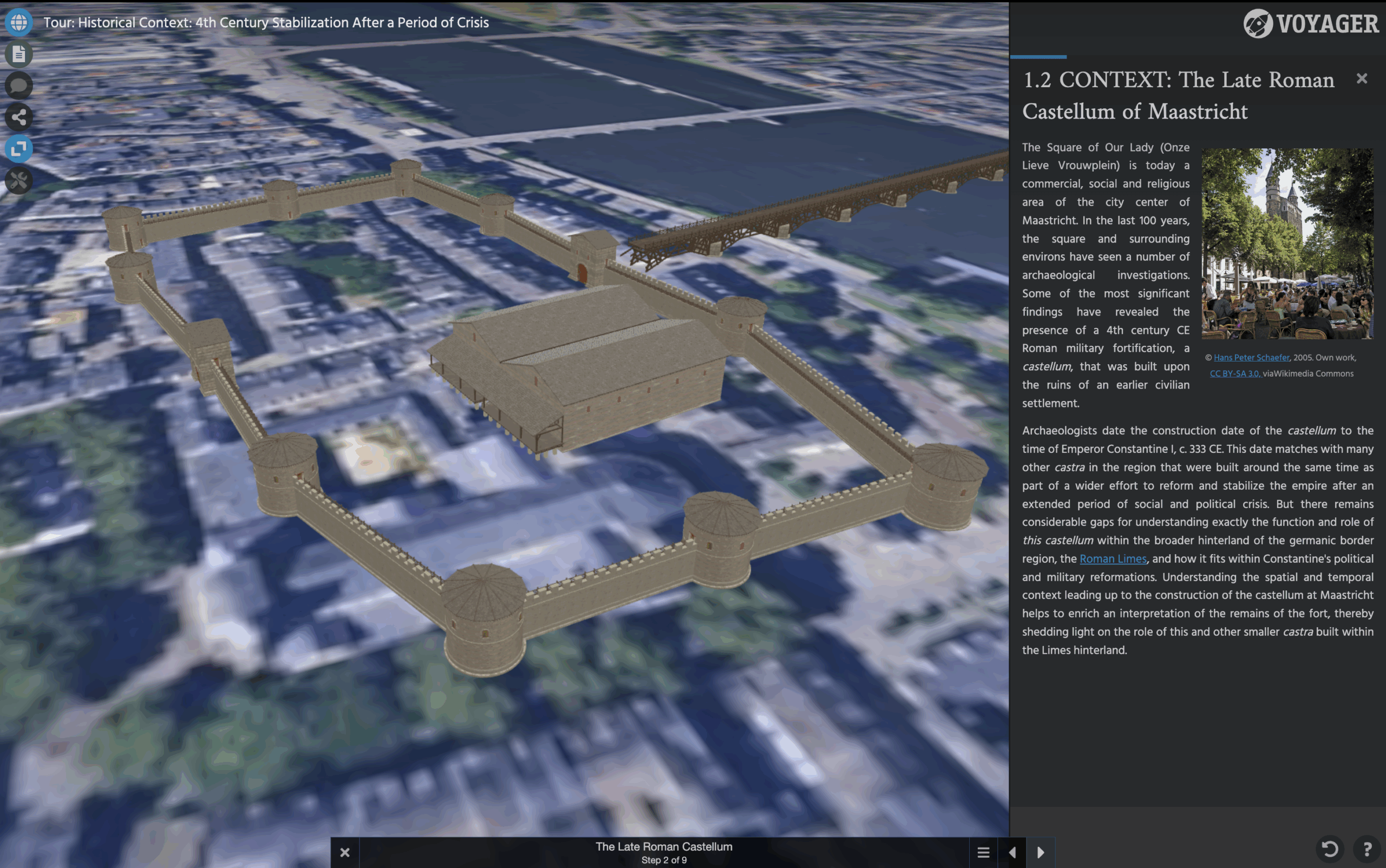
Our very own Kelly Gillikin Schoueri presents today at CHNT2025 on how dynamic maps can enhance archaeological narratives within interactive 3D environments, using the Late Roman Castellum of Maastricht as a case study.
Archaeological storytelling traditionally uses 2D maps and 3D (re)constructions separately. But what happens when you integrate them dynamically within an interactive 3D viewer? How can maps function as more than static references, thus becoming active narrative tools?
Different 3D viewing platforms offer varying affordances. This presentation discusses the open-source 3D viewer, Voayger, designed by the Smithsonian Digitization Program Office and used in the PURE3D research infrastructure as the 3D authoring and viewing interface. Smithsonian’s Voyager places emphasis on user experience and storytelling design aesthetics.
By discussing the 4th-century Roman castellum that lies beneath modern Maastricht’s city centre, Kelly argues that the juxtaposition of 2D maps with 3D volumes, augmented by other forms of multimodality, e.g., annotations, contributes to a growing semantic lexicon for integrating 3D heritage representations with humanity’s richest communicative resource: the map.
To read the conference abstract see: https://drive.google.com/file/d/13JZw5brfvxKgLbeSWsvBfZBW_9VIMugE/view
To read more about the conference see: https://chnt.at/